


Sodium Batteries and EVs That Power the Grid: Inside GM’s Big Energy Push Beyond Electric Cars
The automotive industry is witnessing a massive structural evolution that extends far beyond the highway. General Motors (GM) has officially signaled that its long-term corporate identity relies heavily on becoming a holistic powerhouse for clean energy distribution.
During its highly publicized “GM Empower” event in San Francisco, the American manufacturing giant unveiled an aggressive dual-pronged energy strategy. The organization is introducing built-for-purpose sodium-ion batteries for grid-scale storage while simultaneously activating vehicle-to-grid (V2G) capabilities across its entire electric fleet. Consequently, everyday commuters and major utility companies will soon interact within a highly flexible, decentralized power ecosystem.
Table of Contents
- The Plot Twist: Sodium Batteries Built for the Grid, Not Cars
- Why Sodium-Ion Chemistry Outperforms Lithium in Storage Systems
- Turning Everyday EVs Into Distributed Power Stations
- The Financial Matrix of Second-Life Batteries and LFP Production
- A Vision for a Vertically Integrated Clean Energy Infrastructure
The Plot Twist: Sodium Batteries Built for the Grid, Not Cars
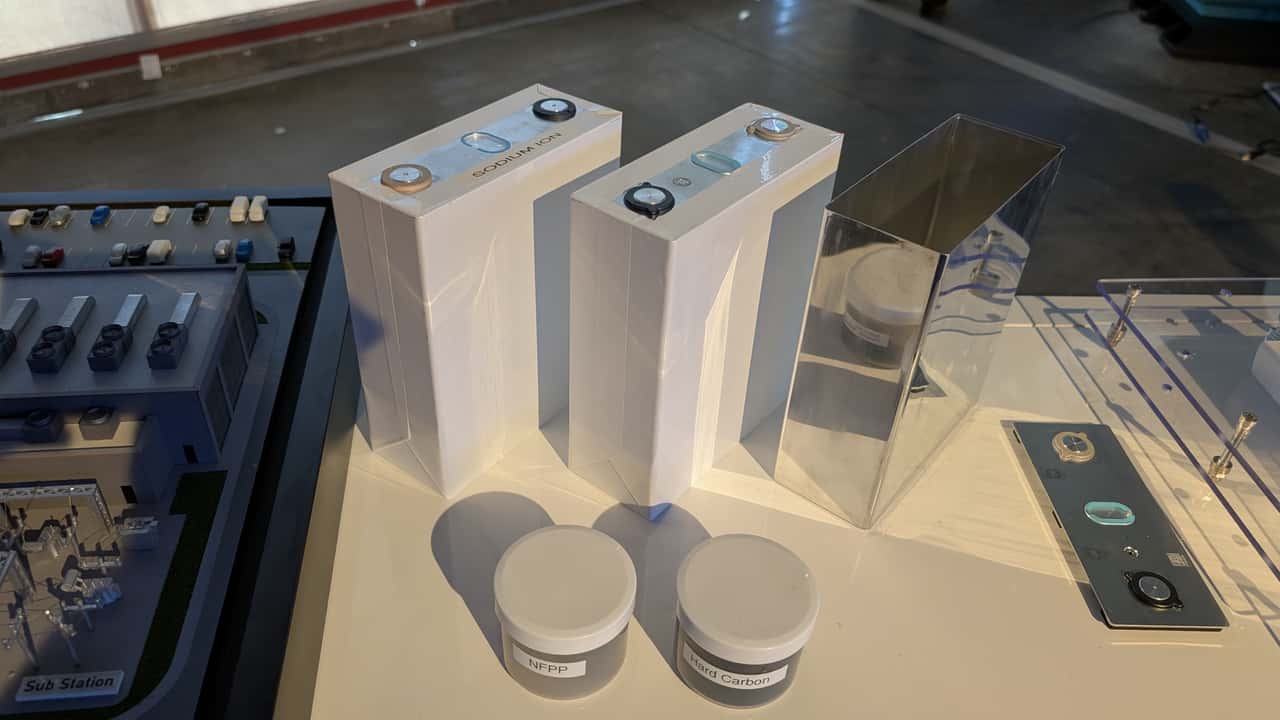
General Motors has officially added a fourth distinct battery architecture to its engineering pipeline. While consumer electric vehicles continue to rely on premium NMCA, LFP, and incoming high-density LMR chemistries, GM’s latest innovation takes a sharp turn toward stationary utility storage.
The company has formed a strategic development partnership with domestic battery startup Peak Energy. Backed by an immediate financial injection from its GM Ventures arm, the automaker plans to prototype next-generation sodium-ion cells. Interestingly, these cells will completely skip passenger cars in the short and medium term due to spatial energy density limits. Instead, technicians will package the units into massive, modular Battery Energy Storage Systems (BESS) designed to protect power grids stressed by wind, solar, and data center demands.
Why Sodium-Ion Chemistry Outperforms Lithium in Storage Systems
When evaluating stationary power setups for a hyperscaler or a local utility provider, physical weight limits and maximum cruising ranges do not matter. Longevity, safety, and raw structural affordability determine commercial viability instead.
Sodium-ion chemistry brings massive advantages to large physical storage facilities:
- No Active Cooling Needed: Unlike conventional lithium-ion setups, sodium cells perform safely across a highly forgiving thermal spectrum. This eliminates parasitic energy losses from complex liquid cooling loops.
- Extreme Thermal Tolerance: The chemistry operates cleanly without risking thermal runaway in hot climates. On top of that, it retains exceptional discharge stability during freezing winter cycles.
- Supply Chain Security: Because sodium is incredibly abundant, raw precursor sourcing bypasses foreign geographical bottlenecks. This allows for highly localized manufacturing lines right inside North America.
- Reduced Lifetime Maintenance: Deleting noisy pumps, radiators, and active plumbing valves reduces the mechanical complexity of the installation. As a result, the hardware functions reliably over a 20-to-25-year lifecycle.
Turning Everyday EVs Into Distributed Power Stations
While massive commercial battery banks fortify the high-voltage national grid, retail passenger vehicles will handle localized neighborhood energy demands. GM is pushing bidirectional charging out as an absolute foundational standard across its entire EV lineup.
[Local Power Grid] <--- (Frictionless Software Layer) ---> [Bidirectional EV Wall Box] <---> [Chevy Equinox / Escalade IQ]
This structural democratization enables everything from high-volume platforms like the Chevy Equinox EV to flagship luxury liners like the Cadillac Escalade IQ to operate as mobile backup generators. By utilizing a newly deployed over-the-air firmware update, owners can seamlessly feed electricity back into residential grids during peak demand hours. According to estimates by GM Energy VP Wade Sheffer, the collective energy capacity of connected GM vehicles currently on the road could comfortably power 120,000 homes for an entire week if called upon during a natural disaster.
The Financial Matrix of Second-Life Batteries and LFP Production
To address near-term utility grid needs before the sodium-ion infrastructure scales to high-volume manufacturing, GM is rolling out a highly diversified intermediate strategy.
| Battery Program Track | Partner Entity Involved | Target Operational Placement | Realized Financial Benefit |
| New Ultium LFP Cells | LG Energy Solution | Commercial stationary energy businesses | Provides quick grid deployment using existing plants |
| Data Center Infrastructure | Redwood Materials | Crusoe’s massive AI data facility in Nevada | Deploys 10,000 batteries to buffer high-performance grids |
| In-House Plant Power | GM Internal Engineering | Assembly factory operations based in Michigan | Saves over $3 Million in local electricity expenditures |
This active recycling philosophy ensures that even when a vehicle chassis faces decommissioning, the chemical stack retains structural utility. Repurposing roughly 100 used EV packs into a cohesive 7.2 MWh factory installation proves that second-life utility layouts are highly profitable today.
A Vision for a Vertically Integrated Clean Energy Infrastructure
Ultimately, GM’s overarching narrative centers on total vertical integration. By developing targeted battery chemistries customized strictly for specific operational tasks, the corporation is successfully reducing its vulnerability to volatile metal markets.
The automotive business will continue to rely heavily on fast-charging, energy-dense lithium profiles to satisfy customer demands for long highway ranges. Concurrently, the new stationary business will deploy cheap, robust sodium hardware to absorb excessive renewable output across the country. By connecting these independent segments via a highly streamlined software layer, GM is laying down the true architectural foundation for a modern, decentralized grid.
To calculate how these international industrial energy shifts impact localized alternative fuel infrastructure and premium electric car pricing frameworks, follow the analytical indices at Bijulidai. Alternatively, discover certified high-efficiency smart home multi-ports, vehicle maintenance adapters, and premium backup power accessories today at Oliz Store.