



Proposed Transport Bill Could Bring Fines of Up to Rs. 50,000 for Traffic Violations
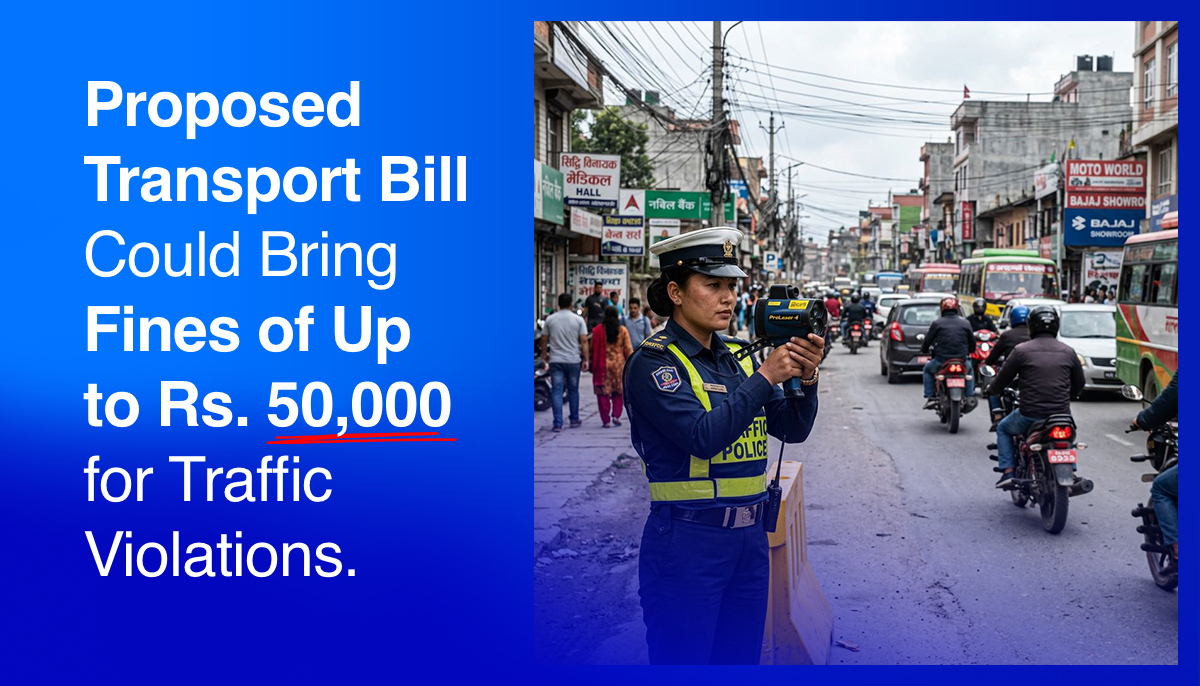
The Government of Nepal is preparing to introduce a much stricter traffic enforcement regime across the country. Through the newly drafted Vehicle and Transport Management Bill, authorities aim to completely overhaul the current penalty system.
Consequently, motorists and public transport operators could soon face massive financial penalties for breaking road rules. The draft bill, prepared by the Ministry of Physical Infrastructure and Transport, proposes a tiered penalty system. Fines will range from a minimum of Rs. 100 to an absolute maximum of Rs. 50,000, depending on the severity of the offense.
Why is the Government Increasing Traffic Fines?
Currently, most traffic violations in Nepal incur a spot fine ranging between Rs. 500 and Rs. 1,500. However, transport officials argue that these minor amounts fail to act as an effective deterrent.
Deteriorating road discipline, rising accident rates, and rampant violations have forced the ministry to take strict measures. Therefore, these heavily increased financial penalties are intentionally designed to compel a massive behavioral shift among drivers.
Furthermore, the bill plans to authorize traffic police and transport inspectors (of at least Assistant Sub-Inspector rank) to issue these high-value fines directly on the spot.
Breakdown of Key Proposed Penalties
The proposed legislation targets dangerous driving habits, registration fraud, and public transport mismanagement. Below is a detailed breakdown of the major penalties outlined in the draft bill.
1. High-Level Offences (Up to Rs. 50,000)
- Driving a Stolen Vehicle: Caught operating a stolen vehicle? You will face the maximum fine of Rs. 50,000.
- Drunk or Substance-Induced Driving (MAPASE): The bill introduces a vehicle-dependent structure for DUI offenses. Heavy and medium vehicle drivers will face Rs. 50,000. Meanwhile, small vehicle drivers face Rs. 35,000, and two-wheelers face Rs. 25,000.
2. Operational & Public Transport Violations
- Lack of Route Permit: Public vehicles operating without an authorized route permit will be penalized Rs. 10,000.
- Overloading Passengers: Public buses exceeding their approved seating capacity on long-distance routes face a steep fine of Rs. 20,000. For medium-distance routes, the fine is Rs. 10,000, and short-distance routes face Rs. 5,000.
- Illegal Use of Registration: Using a vehicle for purposes other than what is stated on its registration (e.g., private cars operating as unauthorized commercial transport) will attract fines up to Rs. 15,000.
3. Everyday Traffic Violations
- Reckless Driving: Endangering other commuters through dangerous maneuvers can cost up to Rs. 25,000.
- Overspeeding: Exceeding designated speed limits will carry fines up to Rs. 5,000.
- Missing Fitness or Pollution Certificates: Operating a vehicle without a valid roadworthiness or emissions test will cost Rs. 5,000 for two-wheelers, Rs. 10,000 for light vehicles, and Rs. 15,000 for heavy vehicles.
- Minor Infractions: Honking in restricted “no-horn” zones carries a Rs. 500 fine. Littering from a vehicle or smoking while driving will cost you Rs. 1,000.
Digital Integration and Tougher Rules for Repeat Offenders
To ensure transparency and curb corruption, the new bill mandates that all traffic fines must be settled digitally. Drivers can pay penalties through the Nagarik App or other government-approved electronic payment systems. If a violator cannot pay immediately, officers will temporarily confiscate their driving license or bluebook. Authorities will return the documents immediately upon electronic settlement.
Warning for Repeat Violators: The bill features a strict multiplier system. Committing the exact same traffic offense a second time brings an automatic 50% surcharge on the base fine. Any subsequent violations after that will completely double the original fine amount.
Public Backlash and Next Steps
Although the ministry hopes to finalize the legislation quickly, the draft bill has faced immediate criticism from the public and lawmakers alike. Many citizens argue that imposing massive fines is highly unfair when the state fails to maintain proper road infrastructure. Potholes, broken traffic lights, and missing road signs make driving inherently hazardous in Nepal.
Critics also point out that a Rs. 50,000 fine is completely unrealistic for average citizens earning Rs. 25,000 a month. Currently, the draft bill is undergoing a detailed review by the Ministry of Law. Before becoming an active law, it must secure approval from both the Cabinet and the Federal Parliament, where significant amendments are highly expected.